CLIA-Certified Microbiome Testing: What Certification Means for Gut Health Sequencing

Microbiome Testing Technology: How Gut Tests Map Functional Pathways
CLIA Certification and Microbiome Sequencing: What It Means
If you are comparing gut microbiome tests, one of the first credibility questions is whether the laboratory behind the sequencing works to recognised quality standards. CLIA-certified sequencing means that the analysis is carried out in a laboratory holding a certificate under the Clinical Laboratory Improvement Amendments (CLIA), the US framework that sets quality requirements for laboratories that test human samples. For microbiome testing, that status is evidence that documented procedures, qualified personnel and ongoing quality checks sit behind the data you receive.
What Is CLIA Certification?
CLIA stands for the Clinical Laboratory Improvement Amendments, a set of US federal regulations administered through the Centers for Medicare & Medicaid Services (CMS). Laboratories that perform testing on human specimens for health assessment are covered by the CLIA framework, and the type of certificate depends on the complexity of the testing involved. Certification covers personnel qualifications, written standard operating procedures, instrument maintenance, quality control and proficiency testing, and it is subject to periodic inspection.
Why CLIA Status Matters for Gut Microbiome Testing
Microbiome sequencing is a chain of many steps: sample collection and stabilisation, DNA extraction, library preparation, sequencing and bioinformatics. Small differences at any of these stages can shift the result, which makes documented procedures unusually important. A laboratory operating under CLIA has defined and monitored each step, keeps records, and takes part in external quality checks. That makes results more comparable over time and more reliable as a basis for discussion with a clinician.
What CLIA Certification Does Not Mean
- It is not the same as FDA clearance or approval of a specific test or device.
- It does not by itself prove that a test can diagnose a particular condition.
- It does not guarantee that every reported finding is clinically actionable on its own.
- It does not replace interpretation by a qualified healthcare professional.
Accreditation tells you how a laboratory is run. It does not tell you what a result means for you personally.

Inside CLIA-Certified Sequencing Technology
Quality accreditation and sequencing technology work together. Accreditation sets the standard for how the laboratory operates, while the sequencing method determines how much of the microbial community the test can actually see.
From Sample to Report: How the Workflow Fits Together
- Sample collection and stabilisation, so microbial DNA reflects the sample at the time it was taken.
- DNA extraction, which must be consistent to allow comparisons between samples.
- Library preparation, where DNA is prepared for the sequencing platform.
- Sequencing, generating millions of reads from the sample.
- Bioinformatics, where reads are quality filtered, classified against reference databases and translated into a report.
Each step is a potential source of variability, which is why validation and quality control are central to CLIA compliance.
16S rRNA Gene Sequencing vs Shotgun Metagenomics
- 16S rRNA gene sequencing targets a conserved marker gene present in bacteria. It is cost-effective and well suited to describing which bacterial groups are present and in what relative abundance, but it offers limited information about what those microbes can do.
- Shotgun metagenomics sequences all DNA in the sample, including bacterial, fungal, viral and other sequences. It can reach species or strain level and can describe functional potential, such as genes involved in short-chain fatty acid production. It generates far more data and requires more complex analysis.
Neither approach is automatically better. The right choice depends on the question being asked, the level of detail needed and the evidence base behind the interpretation.
CLIA vs CAP vs ISO 15189 vs Unaccredited Laboratories
- CLIA certificate: the US regulatory baseline for laboratories testing human samples. It focuses on personnel, procedures, quality control and proficiency testing, and sets the baseline for clinical testing in the US.
- CAP accreditation: a voluntary, peer-based programme run by the College of American Pathologists. It is often held in addition to CLIA, involves detailed checklists and inspections, and is recognised internationally.
- ISO 15189: an international standard for medical laboratories, common in Europe and often used alongside national requirements.
- No stated accreditation or unclear status: quality claims may be difficult to verify, and procedures may not have been independently reviewed.
Many laboratories hold more than one of these. CLIA and CAP are complementary rather than competing, and seeing both is usually a positive sign.
Common Pitfalls in NGS-Based Microbiome Testing
- Low sequencing depth, which under-represents less abundant organisms and makes diversity estimates unstable.
- Contamination, which matters especially in low-biomass samples and can be detected using reagent blanks and controls.
- Inconsistent extraction methods, which make results from different providers hard to compare.
- Reference database gaps, which leave some reads unclassified and can bias the reported composition.
- Over-interpretation of a single snapshot, since the microbiome varies with diet, medication, illness and travel.
- Reports that present relative abundance without clinical context or clear limitations.

Microbiome Testing Technology: How Gut Tests Map Functional Pathways
How to Verify a Laboratory's Accreditation Before You Order
Accreditation is only useful to you if you can check it. Reputable providers can usually tell you which laboratory processes the sample, which accreditation it holds and how that accreditation can be verified.
What a Verifiable Accreditation Claim Looks Like
A useful answer names a specific laboratory, states the accreditation body and certificate type, and explains how a buyer can confirm the claim. In the United States, CLIA certificates can be checked through CMS or the relevant state agency. CAP and ISO 15189 accreditations usually appear in public directories. If a provider cannot name the laboratory or gives only a general promise of quality, treat that as a warning sign.
Questions to Ask Any Microbiome Testing Provider
- Which laboratory processes my sample, and what accreditation does it hold?
- Can you provide the laboratory name and certificate details so I can verify them?
- Which sequencing method is used, and at what depth?
- How has the bioinformatics pipeline been validated, and how are unclassified reads handled?
- What can this test realistically tell me, and what can it not tell me?
- Is a qualified healthcare professional involved in interpreting the results?
- How are my sample and data stored, used and deleted?
Red Flags in Microbiome Test Marketing
- A vague claim of a certified laboratory without a laboratory name.
- Claims that a microbiome test can diagnose or treat a specific condition.
- No description of sequencing method, depth or analysis.
- No stated limitations or uncertainty around results.
- Pressure to buy repeated tests without a clear clinical or personal question.
- Promises that sound more definitive than the evidence allows.
Asking these questions of any provider, including InnerBuddies, is a reasonable part of deciding whether a test is worth buying.
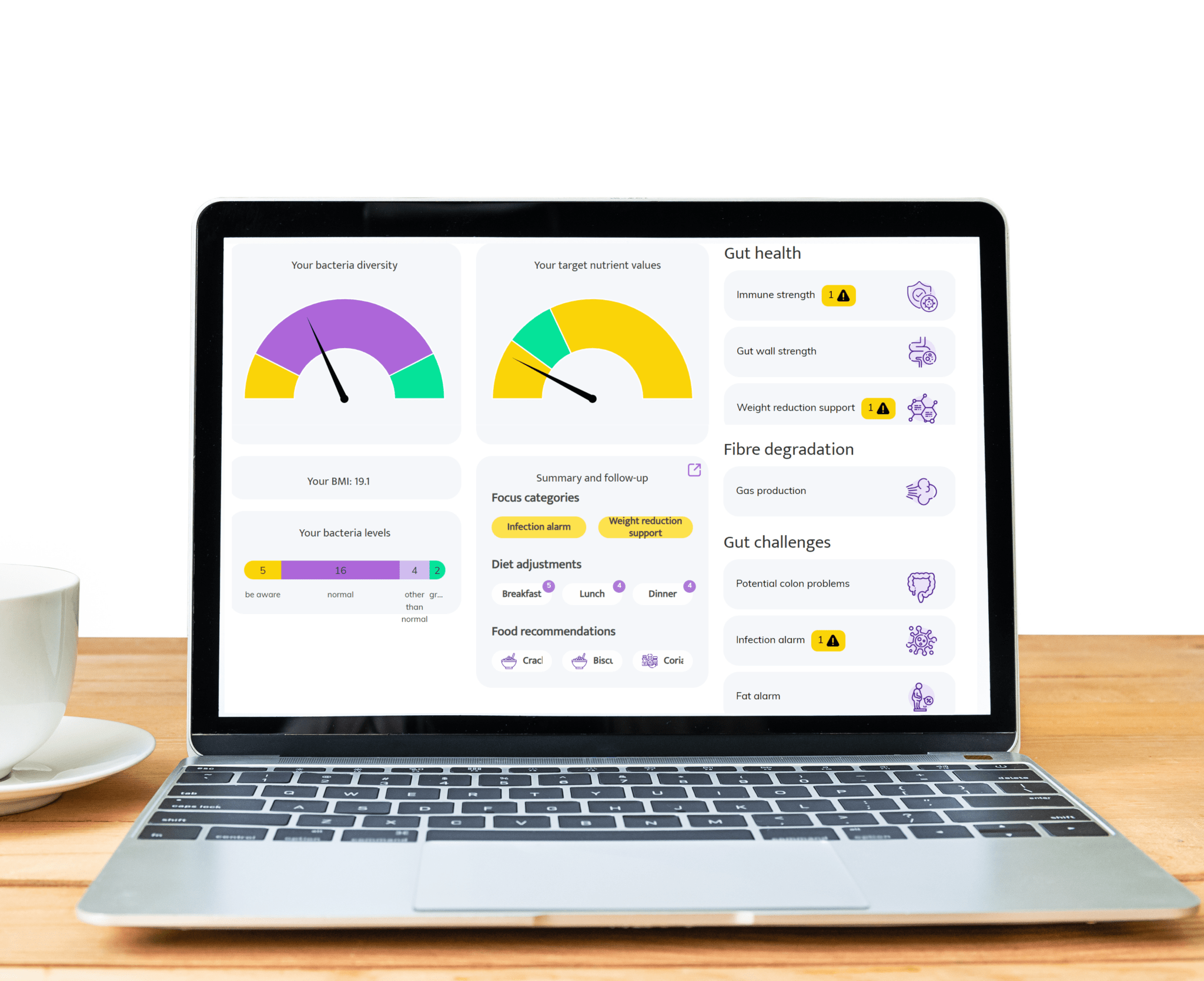
What Microbiome Sequencing Can and Cannot Tell You
Once you know how a test is produced, the next question is what its results are actually good for. Sequencing gives a detailed picture of the gut microbial community, but that picture has boundaries.
Diversity, Composition and Functional Potential
Microbial diversity is often described as an indicator of ecosystem resilience. Tests that measure richness and evenness can show whether the community is diverse or dominated by a small number of groups, and reduced diversity has been associated with conditions such as irritable bowel syndrome and inflammatory bowel disease. Composition tells you which groups are present and in what relative abundance. Functional profiling, usually from shotgun metagenomics, describes genes involved in nutrient metabolism, vitamin synthesis and short-chain fatty acid production, which may inform dietary choices.
Clinical, Research and Personal Applications
- Clinical microbiology and public health: whole genome sequencing is used clinically to identify pathogens, characterise resistance and track outbreaks, where accredited workflows and validated interpretation are essential.
- Microbiome research: sequencing supports studies linking microbial patterns to metabolic, immune and digestive health, and it underpins the development of microbiome-targeted therapies.
- Personal insight: a report can highlight patterns worth discussing with a clinician, such as low diversity or the absence of groups typically associated with fibre fermentation.
- Monitoring over time: repeated testing may show how the community responds to dietary changes, probiotics or treatment, although the clinical value of routine retesting is still being studied.
Where the Limits Are
- Most microbiome findings are associations. A pattern linked to a condition does not mean the microbes cause it.
- A result is a snapshot. Diet, antibiotics, illness, travel and stress can shift composition within weeks.
- Consumer microbiome tests generally cannot diagnose IBS, IBD or other conditions, and should not be used to start or stop treatment.
- Interpretation quality depends on reference databases and reporting, which differ between providers.
The most useful approach is to treat a microbiome report as one input alongside symptoms, medical history and conventional testing, ideally reviewed with a qualified healthcare professional.

Choosing a CLIA-Certified Microbiome Test
With accreditation, technology and limitations in view, the choice becomes more concrete.
What to Look For
- A named laboratory and a verifiable accreditation, rather than a general quality claim.
- A clearly described sequencing method and the depth of sequencing used.
- Reports written in plain language that state what the test cannot tell you.
- Support from qualified professionals when interpreting results.
- Consistent collection and stabilisation instructions, since sample handling affects data quality.
- A clear policy on how your sample and data are stored, used and deleted.
Getting Value From Repeat Testing
Retesting is most useful when the result could change a decision, for example after a sustained dietary change or a course of antibiotics. Tracking trends over months tends to be more informative than reacting to a single result, and repeated testing without a clear question adds cost without adding much clarity.
Frequently Asked Questions About CLIA-Certified Microbiome Testing
How do I get a CLIA certification?
You do not apply for CLIA certification as an individual, because it is issued to laboratories. A laboratory applies to CMS or its state agency, pays the applicable fee, obtains the certificate type that matches the complexity of its testing, and meets requirements for personnel, procedures, quality control and proficiency testing. Compliance is maintained through inspections and renewals.
Is a CLIA certification required?
For laboratories in the United States that test human specimens for health assessment, a CLIA certificate is generally required. Products marketed purely as wellness or informational tools may sit outside that scope, which is one reason it is worth checking accreditation before you buy.
Is sequencing genetic testing legitimate?
Sequencing is a standard, widely used laboratory technology. Whether a specific test is trustworthy depends on the laboratory's accreditation, the validation of the assay and pipeline, and how transparently results and limitations are reported.
How much does it cost to have your entire genome sequenced?
Costs vary widely depending on sequencing depth, platform, data analysis and whether clinical interpretation is included, so there is no single figure. Clinical-grade sequencing with professional interpretation is generally priced higher than consumer or research offerings. The practical step is to request a written quote that states exactly what is included.
The Bottom Line
CLIA certification is a quality signal, not a marketing badge: it tells you that a laboratory is regulated, inspected and required to demonstrate consistent performance. Combined with a clearly described sequencing method, transparent reporting and realistic expectations about what microbiome data can show, it helps you judge a gut microbiome test on evidence rather than claims.
Find more details about CLIA-Certified Gut Testing Technology
You can find more information on the related topics below.
Read more: CLIA-Certified Microbiome Sequencing and What It Means for Your Gut Health
Your Gut Has a Story. Read It — Then Fix Potential Problems
Full microbiome sequencing + Gut Health Index. Metabolic pathways, diversity, keystone species. Personalized plans available (diet, supplements, diary, recipes). EU lab + Maastricht University spin-off + GDPR-safe.